For high-velocity engineering teams

Trunk-Based Development
Wasn't Built for Agentic Velocity.

Continuous integration catches broken syntax after the push. Kawa Code maps developer and AI intent locally to preempt architectural conflicts before they hit your main branch.


The context shift

Why You Use Trunk-Based Dev (And Why It's Breaking)

You chose Trunk-Based Development (TBD) to eliminate long-lived, stale branches and bypass the nightmare of traditional merge hell. It forces rapid feedback loops, relies on fast automated CI pipelines, and thrives on human speed limits.

Then came AI Agents.

When developers deploy tools like Claude Code or Cursor inside a TBD workflow, your main branch moves at a terrifying cadence. Agents generate code and micro-commits 100x faster than humans.

The Result

Your CI pipeline gets congested.

The Collision

Agents pull from main, make massive design assumptions, and push code based on a state of the repository that was true five minutes ago — but is already outdated.

Your tests can tell you if the code compiles. They can't tell you if the AI just violated an architectural guideline — or overrode a teammate's active intent.

A concrete scenario

Claude Code is refactoring auth.middleware. Across the hall, your senior engineer is rewriting JWT signing in the same module. Standard CI sees nothing — neither has committed. Kawa Code intercepts the agent's next tool call: "A teammate is editing lines 142–198 of this file. Coordinate before continuing." The agent pauses. The conflict never reaches main.


The core contrast

Don't just track the lines. Track the logic.

To scale engineering in the agentic era, you have to shift from State-Based Management to Lineage-Based Coordination.

The Old Way

Standard Git + CI

The Kawa Code Way

Preemptive Coordination

Reactive Finds errors only after code is committed and the build fails.
Preemptive Flags conflicts while the AI or human is still typing the prompt.
State-Focused Analyzes the raw text files as they exist right now.
Lineage-Focused Tracks the sequence of choices, forks, and superseded logic.
Siloed Workspaces Blind to what teammates or agents are hacking on locally.
The Control Tower A real-time, shared map of active engineering intent — every HAI pair visible on the same radar.

How it works

Air Traffic Control for Your Logic Stream

Kawa Code introduces a lightweight, continuous Decision Ledger that sits safely above your code repository.

1

Continuous Extraction

Operating passively in the background, Kawa Code extracts micro-decisions from developer prompts and agent behavior — all locally.

Under the hood Two lanes feed the Decision Ledger. The MCP server captures explicit intents and decisions from Claude Code, Cursor, and Windsurf via structured tool calls (create_and_activate_intent, record_decision). Huginn — our editor extensions for VSCode, JetBrains, Emacs, and Vim — captures live edits from human developers by reading the working tree directly.

2

Evolving the Graph

It instantly constructs a temporal knowledge graph of your project's current logic — mapping which design paths are active, abandoned, forked, or superseded.

Under the hood Built on Decision Genomics (a temporal knowledge graph of architectural choices, surfaced where they matter). Each decision carries lineage edges — supersedes, contradicts, specializes — so the graph prunes itself instead of accumulating monotonically like every other AI-memory tool.

3

Preemptive Alerting

If an agent starts refactoring an endpoint using an assumption that conflicts with a change a senior engineer is making across the hall, Kawa Code flags the collision immediately.

Under the hood Powered by intersection detection (patent JP 7150002) — we compare live, pre-commit working trees across HAI pairs and locate the exact line ranges where two contributors' uncommitted edits overlap. The conflict surfaces in the agent's tool response or the developer's editor, well before either touches main.


The technique behind the alert

Intersection Detection — patented coordination, pre-commit
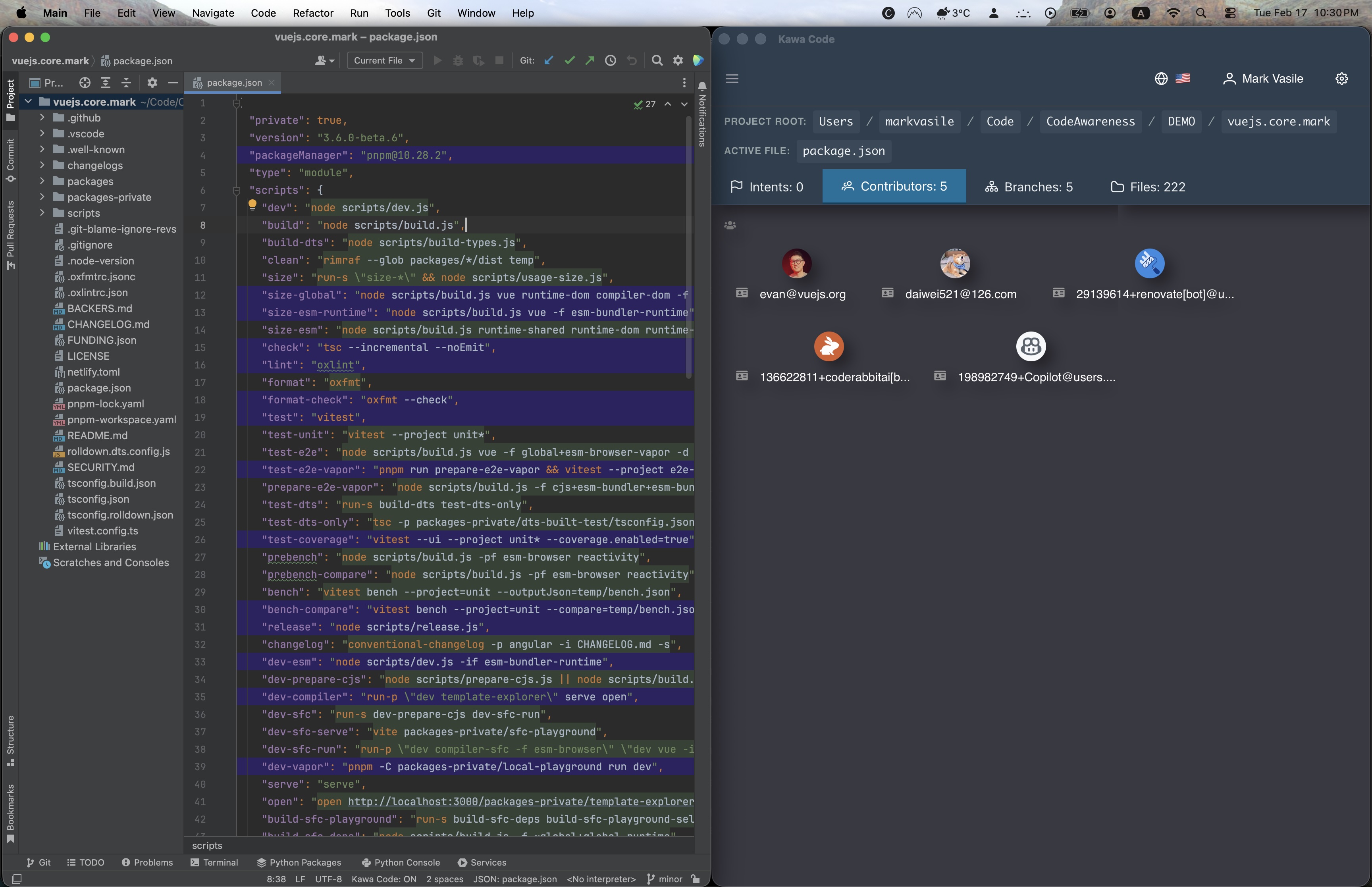
Kawa Code intersection detection across teammates in IntelliJ

See teammates' uncommitted edits — across HAI pairs

Kawa Code highlights the exact line ranges where two contributors' live, pre-commit code differs in the editor. The overlap is computed continuously across the swarm — no one has to push, no one has to ask. The technique is patented as JP 7150002.

Because intersections are detected from working trees rather than commits, the alert fires while the conflict is still cheap to resolve — minutes in, not a merge-conflict review later. Available today in VSCode, JetBrains, Emacs, and Vim.


Addressing your toughest hurdles

Engineered for Sovereign Teams

Zero-Trust, Local-First Security

We know your codebase is your most valuable asset. Kawa Code is built local-first. Metadata extraction, decision logging, and graph mapping happen entirely on the developer's machine or within your secure local environment. Your code never leaves your network, and we never train models on your IP.

Team alignment runs on swarm authentication — continuously confirmed commit-SHA matches across teammates. We never hold a repo access token, never OAuth into your git provider, never clone your repo. Read the full security model →

Protecting Your Existing Tooling Budget

You don't need a new budget line item. We aren't an AI code generator — we recapture the engineering margin AI is eating. By eliminating the hours senior developers spend playing "code archaeologist" to fix AI-hallucinated architecture, Kawa Code turns lost time back into shipped work.


Works with the stack you already have

Editor extensions (Huginn)

VSCode · JetBrains · Emacs · Vim

AI assistants (via MCP)

Claude Code · Cursor · Windsurf


Keep Your Velocity.
Protect Your Trunk.

Stop reacting to broken builds. Start directing the evolution of your software. Join our early access program to pilot Kawa Code with your team.

Get Started with Kawa Code

Free for open-source maintainers.